220 Horizon Dr #212
Raleigh, NC 27615
Tel: (919) 518-2644
Fax: (919) 518-2634


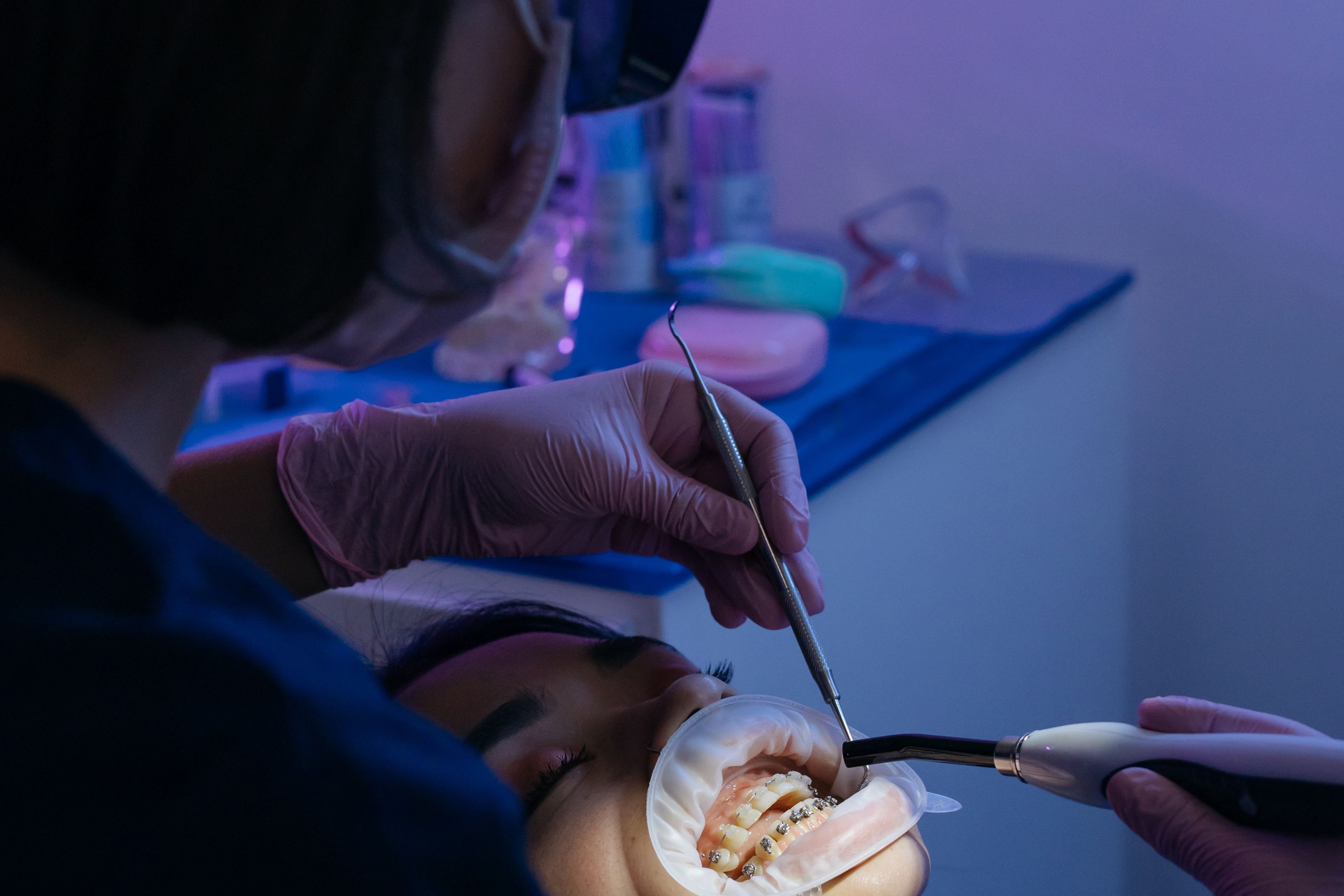
Slowly, through bone, with light pressure that never lets up. That’s how crooked teeth get fixed, and for nearly everyone it means braces or clear aligners. Veneers can disguise mild crookedness, but they leave the bite underneath exactly as it was, so I think of them as a cosmetic cover rather than a correction. Which route makes sense comes down to how crooked the teeth are, your age, and what caused it.
Crowding, usually. The jaw is a few millimetres short of room for the teeth it has to hold, so they overlap or turn sideways to fit. Baby teeth lost too early can do it, and so can a thumb habit, a narrow upper jaw, or simply the family you were born into. Adults see drift too. Lower front teeth that were straight at twenty start leaning on each other by forty. Cleveland Clinic’s page on malocclusion explains how crooked teeth and bite problems connect. Once I know the cause, I know whether we’re just lining teeth up or also changing how they meet.
Braces can handle almost any kind of crooked tooth, from one slightly rotated incisor to severe crowding. Metal brackets are the most common. Ceramic ones blend in with the teeth, and InBrace hides behind them where nobody looks. For big rotations and bite corrections, braces give me very precise control.
Clear aligners, including Invisalign and 3M Clarity, are a series of trays, each one nudging the teeth a fraction further. They come out for meals, they’re hard to spot across a table, and brushing is easy. They work when they’re worn most of the day and night, and many mild to moderate cases suit them well.
A seven-year-old with a narrow jaw or obvious crowding on the way can sometimes benefit from early treatment that makes room before all the adult teeth arrive. An expander, which widens the upper jaw, is a common example. It doesn’t always replace braces later. It often makes that second round simpler.
Not sure which fits you? A free consult will tell you. Call (919) 403-0790 or request a free consultation online.
Answer a few questions about your teeth and what you want, and the quiz will point you toward the options worth talking about at your visit.
This one walks into my Durham office all the time. An adult had braces at fourteen, the retainer disappeared somewhere in college, and now the lower front teeth overlap again. That’s not failed treatment. It’s ordinary drift, and it’s often a short fix with aligners, followed by a retainer they’ll actually wear this time.
Parents worry about these, and I understand why. Crooked baby teeth don’t always mean crooked adult teeth, though. What I watch is how much space the jaw has and whether new teeth are coming in on schedule, and a visit around age seven, which the American Association of Orthodontists suggests, tells us a lot.
People ask about straightening only one tooth. Possible. Teeth are linked through the bite, so moving one usually means at least small changes to its neighbours, and I can show you exactly that on your scan.
Sometimes the fix is small. A single front tooth turned a few degrees might need only a short course of aligners, while one pushed far out of line by crowding usually needs room made around it first.
Overlapping teeth trap food and plaque in corners a toothbrush can’t reach, and that can lead to decay and gum disease. The National Institute of Dental and Craniofacial Research explains how plaque turns into cavities. When the bite doesn’t line up, some teeth also wear unevenly or chip. Plenty of people simply want to smile in photos without thinking about it, which is a fair reason too.
Teeth drift back toward where they started, most of all in the first year after treatment. Retainers stop that. I’ll go through the types of retainers we use; most patients wear one at night long term, and some also get a thin bonded wire behind the lower front teeth. Our retainer care page covers keeping them clean.
The consultation is free. We take digital x-rays and a 3D scan with our iTero scanner, and I’ll point out on the screen which teeth are crooked and why. You’ll leave knowing your options, roughly how long treatment would take, and how insurance and payment would work. My team files most insurance plans.
Both can make room when teeth overlap a lot. Sometimes that’s by gently widening the arch, sometimes by tipping teeth slightly forward, sometimes by polishing a sliver of enamel from between neighbouring teeth. Very rarely, with severe crowding, removing a tooth gives a steadier long-term result, and I’d explain my reasoning before ever suggesting it.
Braces are dependable for big rotations and stubborn teeth. Aligners often suit an adult with mild crowding who’d rather nobody noticed at a work meeting. Teenagers go either way, and many decide based on football, a band instrument, or how organized they are with trays. If there’s also an overbite or crossbite, that goes into the plan, because straightening only the teeth you can see can leave the back teeth meeting badly. I want the smile to look straight and the bite to work, so you aren’t back in my chair in five years. If cost is part of the decision, my team can show you both options side by side after the exam.
I’m Dr. Clay VanderWall, an orthodontist with offices in Durham, Raleigh and Cary. I earned my DDS with honors from the University of Detroit Mercy School of Dentistry, where I joined Omicron Kappa Upsilon, and completed a three-year orthodontic residency at Albert Einstein Medical Center in Philadelphia. I also served on active duty in the U.S. Navy as a dentist. My bio page has more.
Clear aligners are the main alternative and work for many cases. Veneers can hide mild crookedness, but they don’t move teeth or fix the bite.
Mild cases can take several months. Most land somewhere between one and two years, depending on how far the teeth need to move.
Healthy teeth can be moved at any age, and I treat adults every week. See our adult treatment page.
Expect a few days of soreness after new trays or adjustments. Most people manage fine with soft foods.
Our office in Durham, close to Hope Valley and Southpoint, also sees families from Chapel Hill and Hillsborough, and our other locations in Raleigh and Cary serve North Hills, North Ridge, Greystone, North Raleigh, Midtown, Durant Trails, Wake Forest, Lochmere, MacGregor Downs, Regency, Apex and Morrisville. Book a free exam and I’ll show you how we’d straighten your teeth.
Book your free consult with VanderWall Orthodontics in Durham. Call (919) 403-0790 or request a free consultation online.
Visit VanderWall Orthodontics in Durham
3518 Westgate Dr #405, Durham, NC 27707
Phone: (919) 403-0790
Office hours

220 Horizon Dr #212
Raleigh, NC 27615
Tel: (919) 518-2644
Fax: (919) 518-2634
3518 Westgate Dr #405
Durham, NC 27707
Tel: (919) 403-0790
Fax: (919) 490-6665
1815 Kildaire Farm Rd #C
Cary, NC 27518
Tel: (919) 852-0009
Fax: (919) 518-2634